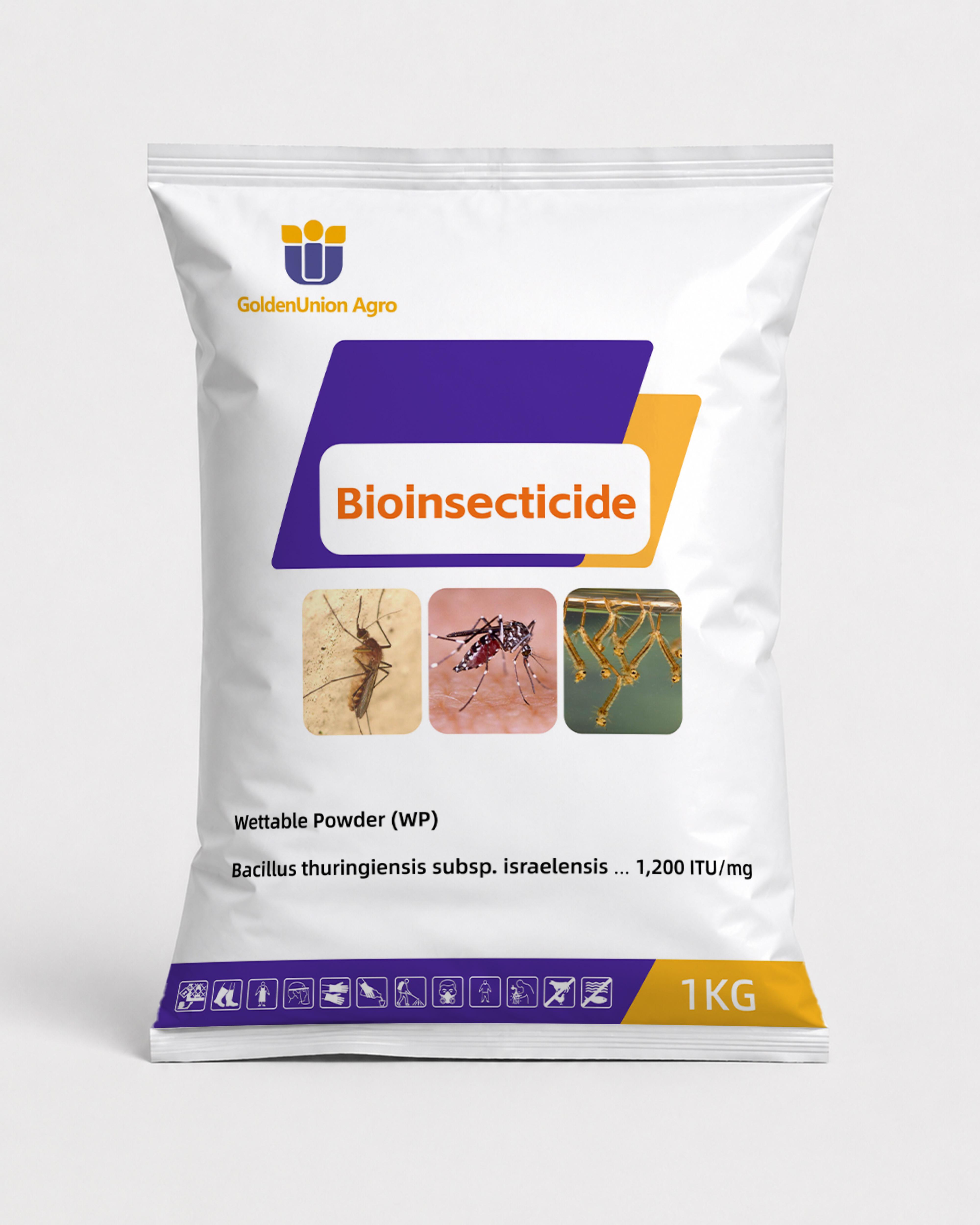
Bacillus thuringiensis israelensis (Bti) 1,200 ITU/mg WP
Active Ingredient
Formulation
Packaging
Bacillus thuringiensis israelensis (Bti)
WP
50~10,000 g/bag
25 kg/drum or bag
Customized packaging & labels available
Available Formulations1,200/ 1,600/ 3,000 ITU/mg WP; 200/ 300/ 400 ITU/μl SC
Technical Material (TC)7,000 ITU/mg
Combination Formulations
Features
Effective against larvae of Aedes, Culex, Anopheles mosquitoes and selected black flies. It is especially suitable for mosquito larval source management in public health vector-control programs.
After ingestion by mosquito larvae, Bti crystal proteins act on the larval midgut, disrupting gut membranes, stopping feeding, and causing larval death.
Mainly suitable for container water, drains, catch basins, rice fields, irrigation ditches, ponds, marshy areas, construction-site water, wastewater ponds, and other mosquito breeding-water habitats where locally registered.
Application Guide
| Application Crops | Target Pests | Recommended Application Rate | Application Timing |
|---|---|---|---|
| Container-breeding Mosquito Control | |||
| Water Containers, Tanks, Buckets, Flower-pot Trays, Small Standing Water | Aedes Mosquito Larvae, Aedes aegypti, Aedes albopictus, Dengue Vectors, Zika Vectors, Chikungunya Vectors | 1–5 mg product/L water
| Apply directly to mosquito breeding water when larvae are detected or before larval populations increase. Re-apply according to residual efficacy, water replacement, rainfall, and local vector-control requirements. |
| Drains / Catch Basins / Urban Standing Water | |||
| Drains, Catch Basins, Roadside Water, Construction-site Water, Wastewater Pools | Culex Mosquito Larvae, Aedes Mosquito Larvae, Urban Mosquito Larvae, Mosquito Larvae in Polluted or Semi-polluted Water | 300–2,500 g/ha water surface
| Apply when mosquito larvae are present and water remains standing. In polluted water or dense organic matter, use the higher label rate or repeat as required. |
| Rice Fields / Agricultural Water Habitats | |||
| Rice Fields, Irrigation Ditches, Field Channels | Mosquito Larvae, Anopheles Larvae, Culex Larvae, Aedes Larvae | 300–2,500 g/ha water surface
| Apply to standing water areas where larvae are present. Use as part of larval source management and avoid treating dry areas where larvae are absent. |
| Public Health Vector-control Programs | |||
| Dengue, Malaria, Zika, Chikungunya Vector-control Programs | Aedes Mosquito Larvae, Anopheles Mosquito Larvae, Culex Mosquito Larvae, Disease-vector Mosquito Larvae | 300–2,500 g/ha water surface or 1–5 mg/L for small container habitats
| Apply before adult mosquito populations increase, especially during rainy seasons, outbreak-risk periods, or after surveillance confirms active breeding sites. |
Target Crops & Pests
No target crops data available
No control objects data available